Indicators
MT5 ATR: volatility, price units and useful normalization
True range includes gaps
ATR summarizes recent true ranges. True range takes the largest of high−low, the absolute distance from high to previous close, and the absolute distance from low to previous close. This lets a gap matter even when the current candle itself has a narrow high–low range.
For a synthetic bar with previous close 100, high 108 and low 105, the three distances are 3, 8 and 5. True range is 8. Looking only at the candle's height would miss most of the movement from the previous close.
ATR is a price distance
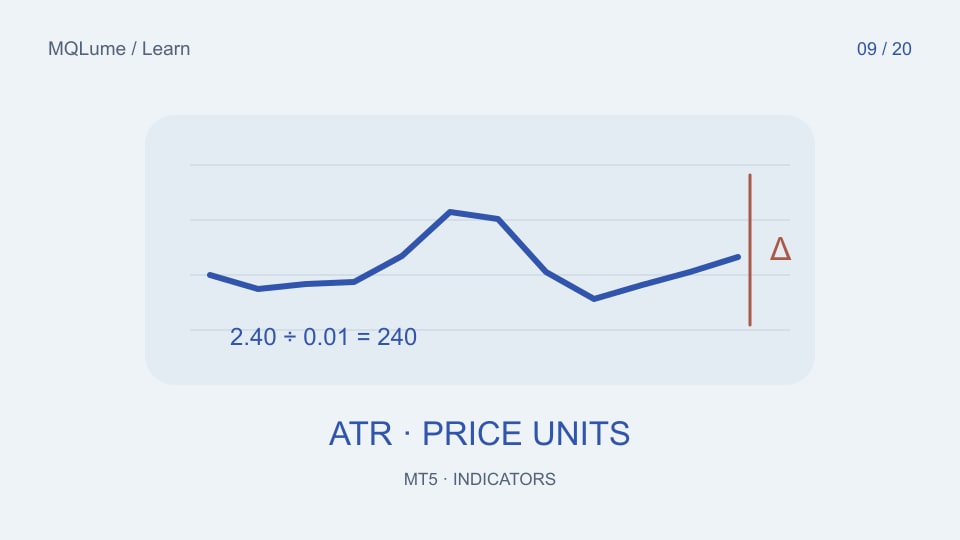
An ATR value of 2.40 is in the symbol's price units. It is not automatically 2.40 pips, dollars of account loss or a percentage. Convert it using the symbol's actual point or tick size when that is the unit your code expects.
With an illustrative tick size of 0.01, a price distance of 2.40 is 240 ticks. This example says nothing about the monetary value of one tick for your position size. Tick value and contract specifications belong to a separate calculation.
Normalize only for a defined comparison
To compare relative movement across differently priced instruments, one possible descriptive measure is 100 × ATR / close. If ATR is 2 and close is 100, the result is 2%. A close of 1,000 with the same ATR gives 0.2%. These are synthetic values showing why raw ATR cannot be compared blindly.
Use consistent timeframe, period, price feed and smoothing assumptions. A daily ATR and a five-minute ATR answer different questions. A normalized value is still an observation of past movement, not a probability that the next candle will remain inside a particular range.
Use it as context, not direction
ATR can help describe whether a test interval is relatively quiet or volatile, or express distances in a common research unit. An “ATR multiple” in a hypothetical stop rule remains a rule to test, not a guarantee that loss is bounded by that amount.
If you experiment with ATR-based distances, state whether the ATR is sampled at entry and frozen or updated afterward. Also specify how a widening value affects an existing position. Two implementations with the same multiple can behave very differently.
Check the conversion chain
Record timestamp, raw ATR, close, symbol tick size and any converted distance. Recalculate one row by hand. Check a gap, a quiet period and a change in timeframe. Compare raw values before rounded display values.
Keep volatility measurement separate from position sizing. The points, pips and tick-size guide covers unit differences, while the validation lab explains how to evaluate an indicator-dependent rule without assuming its effectiveness.